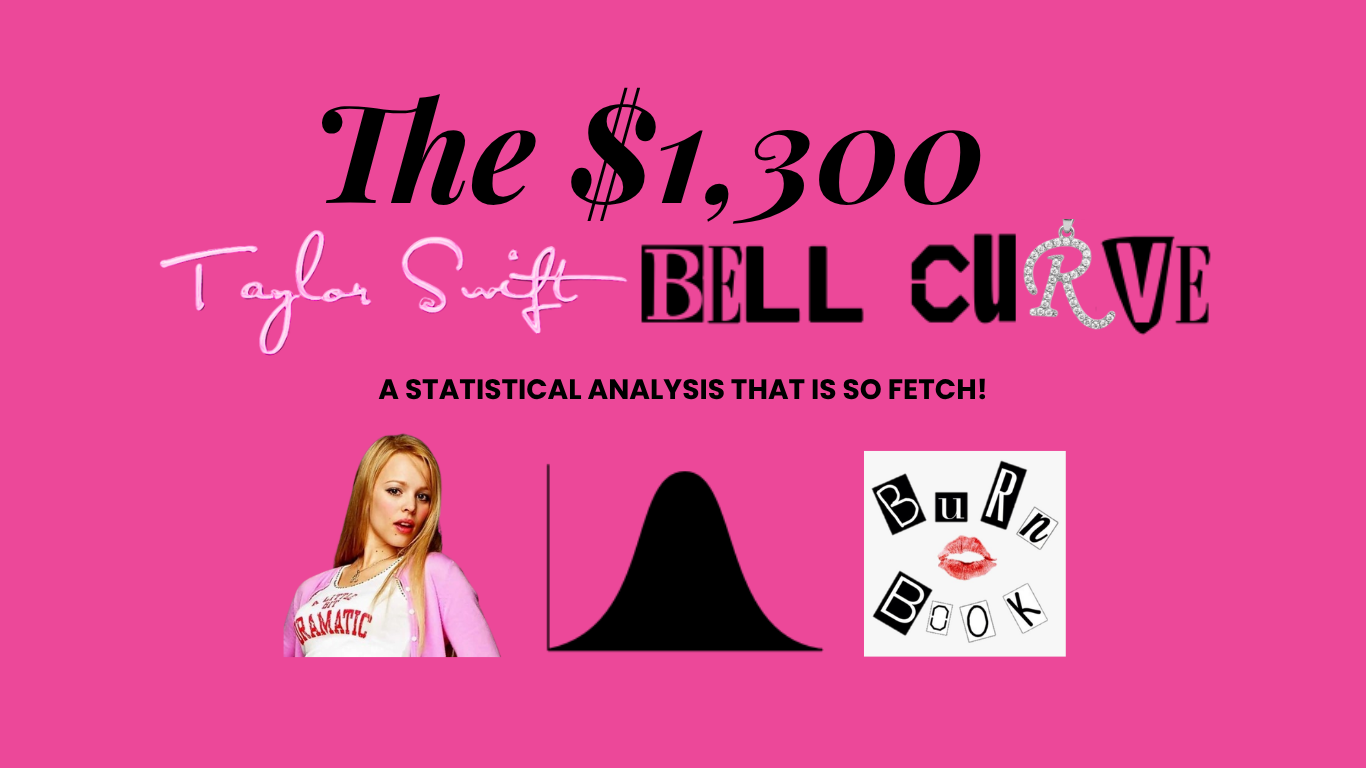
What if I told you that economics professors, data scientists, and Taylor Swift fans are all obsessed with the same thing? Bet you couldn’t figure it out even if you Googled Gretchen Wieners’ hair. It’s a bell curve. I know, right?
I know what you're thinking: 'Statistics? Ew.' But when it's about how much people spend on Taylor Swift, suddenly you're interested. Typical.
Whatever, we're getting into how Taylor Swift fans spend their money, and why literally no other fandom can sit with us on this one.
The $1,300 Reality Check
During the Eras Tour, the average Swiftie spent around $1,300 per concert. And that's before tickets, which is literally just the entry fee. We're talking hotels, travel, outfits you bought specifically to be in someone's Instagram story—that's a nice skirt, where did you get it?—yeah, so basically everything needed to prove you were there.
But here's what makes this actually interesting: that $1,300 isn't random. It's the peak of a bell curve. A perfect, mathematically gorgeous bell curve. Which is, like, extremely rare.
Bell Curves for People Who Texted During Math Class
Bell curve 101: most data clusters in the middle, extremes taper off at the edges. It's called a bell curve because it looks like a bell. Someone really went all out with that name.
Bell curves show up constantly - your height, your SAT scores; lost you! How many times did you stream The Life of a Showgirl? Oh, there you are again. Anyway, point is, they're literally just basic science. Which makes this fandom thing actually interesting.
But in music fandoms? Practically never happens. Which makes this whole thing, like, so fetch.
The Three Types of Swifties: A Hierarchy
Let's break down the spending groups. Try to keep up.
The Regional Attendees
These fans live close to the venue. Like, they can literally Uber home. They grab some merch, have a time, and spend between $200-$400. Which is so adorable. They're on the left side of the curve, wearing army pants and flip-flops. Bless.
The Core Fans
The center of the curve. Where "normal" people live. These fans drop that full $1,300 on travel, hotels, coordinated outfits, exclusive merch - the standard. They're committed without being, like, concerning about it. This is the baseline.
The Super-Fans
The right side of the curve. Where the real ones live. Multiple shows? Obviously. Cross-country flights? Standard. VIP packages? Did you even go if you didn't? Custom ensembles? It would be embarrassing not to. We're talking $3,000-$5,000+, besides of course, getting their hair insured for $10,000. For them, it's everything.
Why Other Fandoms Could Never
Look, Beyoncé's Beyhive is, like, whatever. BTS's ARMY? Totally. Bad Bunny's fans? Ugh, I could find them anywhere. But they don't create this statistical pattern. And here's why, but you can't tell anyone.
Scale and distribution. Pay attention.
The Eras Tour generated an estimated $4.6 billion in consumer spending. That's right, with a B. Yeah, that's "we're analyzing this in economics class now" big. At that scale, you don't just have a few obsessed fans throwing off the average. You have millions of people distributed across every single spending level, creating the most statistically perfect bell curve anyone in pop-culture has ever seen.
Even the "low-spending" fans on this curve? That's still millions of people. More than most artists' entire fanbases. Combined. So yeah, grool.
Other fandoms have extremes - budget fans and superfans - but they don't have the middle to make it work. They're trying to make a bell curve happen. It's not going to happen.
The Taylor Swift Effect Is an Actual Economic Term Now
Get in, loser. We're doing economic analysis.
"The Taylor Swift Effect" became something actual economists had to study. Cities calculated her local economic impact, like, she was a weather event or something. Hotels, restaurants, transportation - everyone reported massive spikes. Economists published peer-reviewed studies, or whatever, about it. With footnotes.
There are research papers. With citations. About Swiftie spending habits. I know.
No other fandom has produced such a consistent, large-scale, measurable economic pattern. She isn't just, like, relevant. This is quantifiable data. You can make, I think, pivot tables about it. You can run regression analyses. It's that legitimate.
The Final Word
So what does this $1,300 bell curve actually mean?
So like, wow, Swifties aren't just like, super obsessed fans? They're a "statistically significant economic force"? That's like, totally nerdy and obsessed. Everyone gets to be a little data point. How cute.
Taylor Swift created an "economic phenomenon" that shows up in city budgets, gets analyzed by people with actual PhDs, and like, fundamentally changed how we understand fandom economics in the streaming era. That's so extra.
You know the rules, on Wednesdays we wear pink and generate "statistically perfect bell curves", because nothing says "My music habits are not obsessed" like being a literal data point in a statistical analysis about a pop star. But, you do you.
K, love you, bye.